

Seller Credits in Collin County: How to Price for One, How to Ask for One
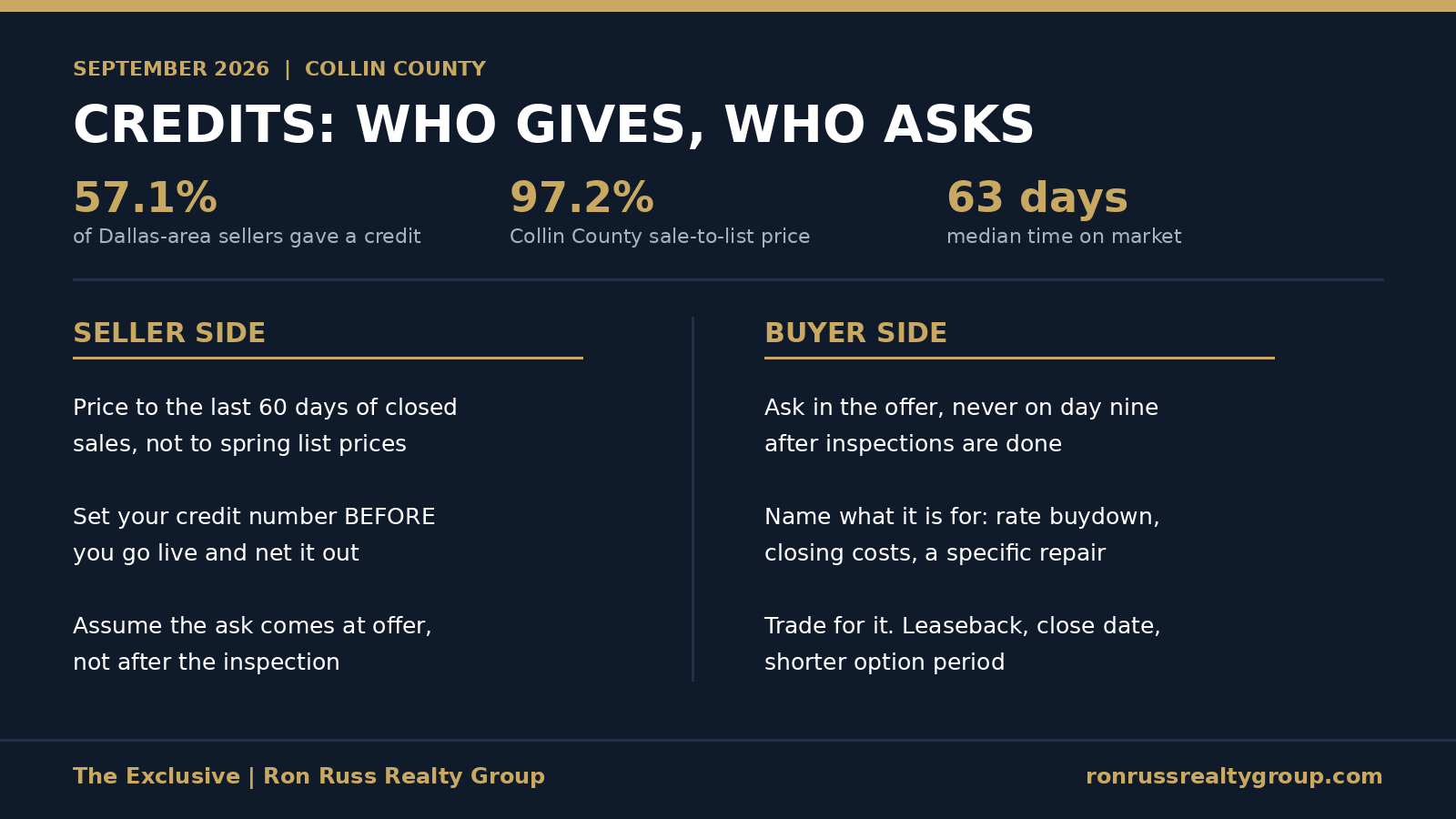
Nearly six out of ten sellers around Dallas handed money back to their buyer at the closing table in the most recent read I have seen. That is 57.1 percent, up almost eight points from a year ago. Credits are not a last resort anymore. They are a line item, and you should plan for one on both sides of the deal.
Here is the part that stings. Across Collin County, homes closed at 97.2 percent of list over the three months ending in August. On a $600,000 asking price that is roughly $16,800 gone before anyone says the word credit. Then the credit request lands on top of it.
That is the whole issue this week, and it cuts both directions.
Sellers: price it so you are not paying twice
The pattern I keep seeing: list at the number you wish you could get, sit 45 days, cut the price, and then still get hit with a credit request in the contract. That seller paid for the same soft market twice. Once in the price cut, once at closing.
Price to the last 60 days of closed sales in your subdivision, not to what your neighbor listed at back in the spring. Then decide before you go live what your credit number is and build it into your bottom line. I would rather list at $585,000 holding $10,000 for the buyer than go on at $610,000 and bleed $25,000 across three months of chasing the market down. The first one closes in 30 days with a better net. The second closes in 90 with a worse one.
One more thing worth knowing. Right now credits are getting negotiated off the original contract price, before the inspection is even finished. So assume the ask is coming at the offer stage. If you are counting on a clean inspection to protect your number, you are defending the wrong round.
Buyers: ask in a way that gets a yes
Credits are real money and you should absolutely ask for one. But how you ask decides whether you get it.
Ask in the offer, not after. A seller who sees the number on day one can price it into their decision. A seller who gets surprised on day nine, after turning down two other buyers, digs in and starts resenting you.
Name what it is for. “$12,000 toward a rate buydown and closing costs” reads completely differently than “$12,000 off.” The first sounds like a buyer solving a payment problem. The second sounds like a buyer who thinks the house is overpriced.
Trade for it. Give them the leaseback they want, the closing date they need, a shorter option period. Sellers give credits to buyers who make everything else easy.
What kills deals is the double dip. Negotiating hard on price, winning, then coming back after inspection for another $15,000 on things you could see in the listing photos. Do that and you burn the goodwill you need for the repair that actually matters.
Run the math before you pick
At today's rates, a price cut and a credit are not the same tool. On a $580,000 loan, a $20,000 price reduction takes roughly $135 off the monthly payment. That same $20,000 spent buying the rate down can take $300 or more off, depending on what your lender's pricing looks like that day. Same money out of the seller's pocket, very different result for the buyer. Decide which one you want before you write the offer.
What I am watching this week
The Fed meets this week and the odds of a hike have been running close to a coin flip. Rates already priced most of that in, so I am not expecting a jump on the announcement itself. I am watching the 10-year Treasury instead. It pushed through 4.9 percent last week, its highest since 2023, and that is what actually moves mortgage rates.
I am also watching the calendar. The last week of September is usually the softest week of the year for buyer competition. If you have been sitting on the fence, that window opens in two weeks.
If you want to know what a credit would actually cost you as a seller or save you as a buyer, reply or send me a note and I will run your numbers. No pressure either way.